Read The state of nature in John Locke, Thomas Hobbes and Jean-Jacques Rousseau - Thomas Hühne | ePub
Related searches:
State of Nature or State of War? Locke and Hobbes discussed. by
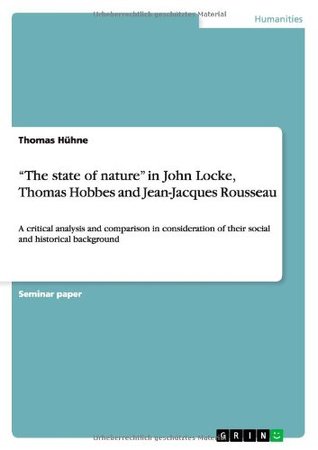
The state of nature in John Locke, Thomas Hobbes and Jean-Jacques Rousseau
The State of Nature and the State of War According to Hobbes and
Hobbes, Locke, and the State of Nature Theories - Denison Digital
Locke, Nozick and the state of nature SpringerLink
The State Of Nature In John Locke And Jean-Jacques Rousseau
On leaving the State of Nature and Consent to Government
state of nature Definition, Theories, & Facts Britannica
State of nature - Wikipedia
“The state of nature” in John Locke, Thomas Hobbes and - GRIN
John Locke on “perfect freedom” in the state of nature (1689
Locke's State of Nature - JSTOR
Locke's Perspective of State of Nature - Your Article Library
Preface, Chapters 1-2: Of the State of Nature - SparkNotes
John Lockes State Of Nature Philosophy Essay
Punishment in the State of Nature: John Locke and Criminal
The State of Nature According to John Locke Essay - 472 Words
The State of Nature: Thomas Hobbes vs. John Locke - Owlcation
Second Treatise of Government Chapter II: Of the State of
State of Nature: Definition, Philosophy & Examples - Video
The State Of Nature, Social Contract By John Locke : Current
John Locke and the “Law of Nature” – Discourses on Minerva
THE GROUND OF LOCKE’S LAW OF NATURE
The State of Nature; John Locke Flashcards Quizlet
Second Treatise of Government Chapter III: Of the State of
The political theories of thomas hobbes and john locke concerning the state of nature and the state of war are substantially different due to disagreements.
The major purpose of this project revolves in stating and analyzing the theory of the state of nature, social contract as seen and conceived by john locke. ” the state of nature is governed by a law that creates obligations for everyone.
One possible starting point for a substantive discussion regarding the nature and purpose of punishment is the political philosophy of john.
Like hobbes, locke explains the civil society by first addressing the state of nature.
The state of nature in locke's theory represents the beginning of a process in which a state for a liberal, constitutional government is formed.
Locke's account in contrast, locke’s state of nature is seemingly a far more pleasant place to be than hobbes’. He also gives laws of nature, ‘that mankind is to be preserved as much as possible’. This comes from the idea that we are god’s property and should not then harm one another.
John lockes state of nature is where humans exist without an established government or a social contract. It is a state of anarchy where there is completely no order or rules that guide human behavior. There are no laws to govern us and we are guided by our own instincts on what is right and wrong.
What we can say for locke, however, is that the law of nature must first descend into the state of war before becoming moral in its application. From locke’s perspective the law of self-preservation will eventually force us into recognizing the law as being universal in scope, rather than purely self-situated; even if the law is “self.
Locke is clear that he understands in a state of nature if men are called upon to be a judge of them or their friends they may be unable to be impartial or disinterested. The remedy for this is a civil government with the power to adjudicate, but there can be problems with this state of affairs as well.
But the state of nature is probably also, as john dunn has observed,2 the most misunderstood idea in locke's political philosophy.
For locke, by contrast, the state of nature is characterized by the absence of government but not by the absence of mutual obligation.
Locke's state of nature is often contrasted with that of thomas hobbes's, with which he would have had some familiarity either.
Both thomas hobbes and john locke utilize a state of nature construct to elucidate their more general views onhuman nature.
In contrast, locke's state of nature is seemingly a far more pleasant place to be than hobbes'.
According to locke, individuals have rights which precede any social contract as well as a set of duties.
John locke thomas hobbes round 1: human nature according to locke, the natural condition of mankind is a “state of nature” characterized by human.
The state of nature is a perfect state of liberty where individuals enjoy natural rights. It is not a state of war and thus for locke, it was a state of perfect equality and happiness.
For locke, in the state of nature all men are free to order their actions, and dispose of their possessions and persons, as they think fit,.
Locke states that natural law simply demands that punishment fit the crime--a person in the state of nature can redress any crime to discourage the offender from.
In john locke and jean-jacques rousseau’s theories, the state of nature is pre-political. It aims to explain the origin of the political order and the legitimacy of human society. Men in locke’s theory give up their perfect freedom in the state of nature to secure the advantages of civilized society (locke 495).
Before the appearance of political institutions) human beings enjoyed what he called “perfect freedom” to enjoy their.
Did john locke believe in state of nature? locke believed that in a state of nature, people protect their natural rights – life, liberty and property- by using their own strength and skill. The weaker and less skilled would find it difficult to protect their rights.
Locke (in the second of the two treatises of government, 1690) differed from hobbes insofar as he described the state of nature as one in which the rights of life.
Learn vocabulary, terms, and more with flashcards, games, and other study tools.
Locke's commonwealth three requirements on government government’s power can never extend farther than the common good. Government is required to secure everyone’s property by providing against the three defects of the state of nature. Government is required to promote the peace, safety and public good of the people.
For locke, the state of nature is where humans exist without an established government or social contract. In a since the state of nature is a state of anarchy, of no order. What john locke believed about the state of nature was that if men could act in a positive way, they could reach order without being absolutely controlled by one person.
Post Your Comments: