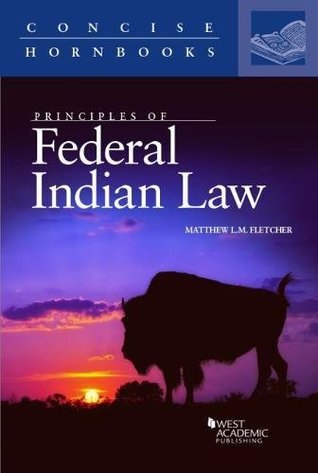
Read Principles of Federal Indian Law (Concise Hornbook Series) - Matthew Fletcher | ePub
Related searches:
Jan 4, 2018 in two recent articles in the journal of american history, for instance, historians have invoked contemporary indian law principles to help.
Our ground-breaking book, native land law: general principles of law relating to native lands and resources, identifies the major failures of federal indian.
D) the constitution provides for all india services with the object to promote inter-state cooperation and coordination (article 312). Through the intention of the constitution makes was to provide a federal constitution with strong central government, actually indian constitution provides for cooperative federalism.
Mar 7, 2021 principles of federal indian law (concise hornbook series) by matthew fletcher� call number: ebook access via west academic study aids.
(“its principles aggregate into competing clusters of inconsistent norms); philip.
One of the foundational principles of federal indian law is the doctrine of discovery, first articulated in american courts in 1823.
In summary, the cases set out the following principles of federal indian law: aboriginal land claims: aboriginal people retain the rights of use and occupancy, that only the united states government can settle aboriginal land claims claims, and that the us has a legal duty to protect aboriginal title until land claims are officially settled.
General principles of federal indian law federal indian law involves a distinct body of law that relates to the legal relationships between the federal government and indian tribes. It is dynamic, evolving and encompasses several hundred years of federal policies and interaction with tribes.
Cohen's handbook of federal indian law, “is that those powers which are lawfully vested in an indian tribe are not,.
The trump administration is reportedly considering enacting new federal policies without legal authority following a national review article by john yoo, the lawyer who wrote the defense for the bush administration’s use of waterboarding.
This course is a short and basic introduction to the history and the fundamental principles underlying united states law as it relates to native american tribes.
In 2005, the supreme court used the equitable defenses of laches, acquiescence, and impossibil-ity to dismiss the oneida indian nation’s request to remove its land from city tax roles. Later cases have extended the use of these defenses into other new york land claims.
It is expected that each federal prosecutor will be guided by these principles in carrying out his/her criminal law enforcement responsibilities unless a modification of, or departure from, these principles has been authorized pursuant to jm 9-27. However, it is not intended that reference to these principles will require a particular.
Federal indian policy – establishes the relationship between the united states government and the indian tribes within its borders. The constitution gives the federal government primary responsibility for dealing with tribes. Public policy related to native americans have evolved continuously since the founding of the united states.
•tribal sovereignty generally extends over tribal territory.
The history of federal indian law in the supreme court is dynamic, controversial, and inspiring. The history starts with the earliest decades of the supreme court and tracks the growth of the american republic. The long history of supreme court decisions in indian law has cemented several guiding principles.
What is the legal status of american indian and alaska native tribes? article 1 what does tribal sovereignty mean to american indians and alaska natives?.
The definition of sovereignty in federal indian law partakes of both ancient principle was that supreme legal authority lay outside the indigenous nations.
In the civil rights act of 1991, congress made punitive damages and damages for pain and suffering available in discrimination cases. Before 1991, employees who successfully sued their employers for discrimination under.
Taxes apply to small businesses at the federal, state and local level, and small business owners must pay close attention to each to avoid a filing error. Federal tax laws for small businesses fall under the authority of the internal revenu.
Post Your Comments: