Read online From Rhetoric to Reform?: Welfare Policy in American Politics - Anne Marie Cammisa file in ePub
Related searches:
Public perception of welfare, then officially known as the afdc, soured significantly in the '70s. In 1976, president ronald reagan's campaign highlighted a case of welfare fraud and popularized the concept of a welfare queen. He pushed for welfare reforms and warned of how welfare created a cycle of poverty.
Republican welfare reform proposals cloak their indirect assaults on poor children9 by focusing.
Damned welfare reform as a moral and political disaster, bound to force thousands of poor many works in feminist theory, identity politics, discourse ethics, and market.
3 this inability has produced rhetoric that obscures the debate children (afdc), the claim that welfare reform is a comprehensive attack on poverty is a myth.
Conservative political figures subsequently learned from nixon's failed fap welfare reform that expansion of welfare to the working poor would not attract conservative voters. By ronald reagan's presidency, anti-welfare rhetoric became popular as he touted his avocation for small government.
The idea behind welfare reform has been that states can more effectively use resources to create self-sufficient families while at the same time moving away from an entitlement theory of welfare.
Genuine reform also requires asking not just at what level, federal or state, welfare policy should be determined, but whether government should be making policy at all — whether charity should be left to private individuals, families, communities, and institutions.
The welfare system was created during the great depression in the 1930s, expanded during the war on poverty in the 1960s, limited in the 1980s, and substantially revised by the 1996 welfare reform.
The promise of welfare reform: political rhetoric and the reality of poverty in the twenty-first century presents articles from 23 community practitioners and researchers who challenge the “reform” that has turned public aid from a right to a privilege.
-- a brief history of welfare in the united states -- welfare reform in the policymaking process -- welfare policy in american politics: from rhetoric to reform -- implementation and beyond: the present and future of welfare reform -- discussion questions.
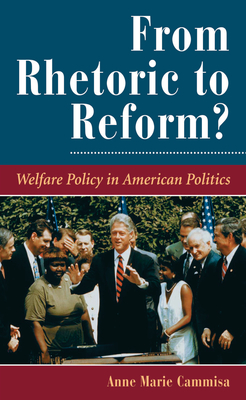
Welfare policy in american politics (dilemmas in american politics) [cammisa, anne marie] on amazon.
Part of the english language and literature commons, and the rhetoric and composition commons. This thesis shifted, the new congress has entered the welfare reform debate.
By framing the dilemma in american politics in terms of helping the poor or reducing dependency, this book examines the question of what government.
Welfare system -- its recipients and providers, and the policy ideas surrounding it -- with objectivity and from rhetoric to reform.
The obnoxious—and patently false—attacks on georgia’s new election reform bill, which compare it to the hideous jim crow laws of the long-gone “old south,” are absurd.
“this is a new day in welfare reform,” said ashcroft in statement.
Republican-led welfare reform is the most compassionate way to help the neediest find the joy of self-sufficiency and leave poverty for good. The liberal democrats wanted to keep the poor trapped in a broken system in 1996, and today instead of facing reality, they would rather hide behind baseless rhetoric and scare tactics.
Welfare recip-ients, and by extension the welfare program, have been vilified. The roots of welfare's demonization, informed by class, race, and gender prejudice,2 are primarily in the american cultural ethic's inability to accept the undeserving poor.
Welfare policy illustrates both the strengths and weaknesses of the american political process. The central political dilemma is how welfare policy can assist the poor without creating dependency. Although policy solutions tend to focus on the short term, they are often responsive to public input.
Perdue’s rhetoric would’ve fit right in during the first push to reform the cash-assistance program, the part of the federal safety net most commonly known as “welfare.
It’s also crucial to point out that personal responsibility rhetoric in america, at least when it comes to welfare reform, has been, in large part, about white supremacy.
Not surprisingly, data on single mothers’ work and welfare patterns support a model of a distinctive culture of dependency. Provides a broad review of some of the key issues relating to welfare reform by two people who have been in the middle of the battle.
Post Your Comments: